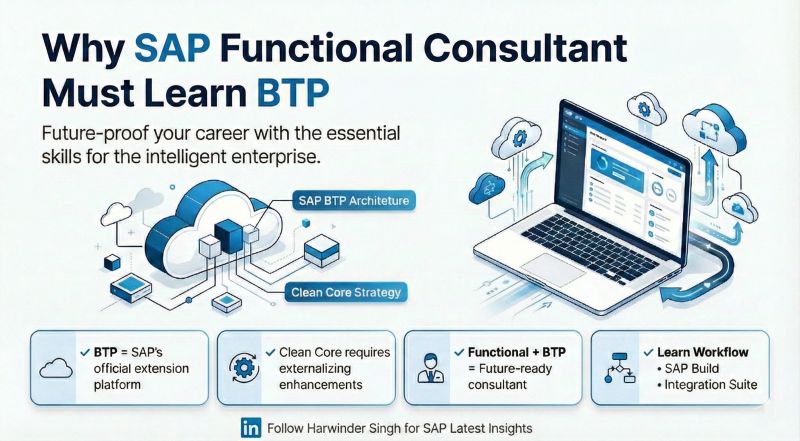
Why SAP BTP Matters: The Technical Foundation of SAP Ecosystem
In the rapidly evolving landscape of enterprise technology, businesses are constantly seeking agile, scalable, and innovative solutions to stay competitive. This pursuit often leads them to complex challenges around data management, application development, system integration, and leveraging emerging technologies. Addressing these demands, SAP introduced a unique and powerful solution offering in January 2021: the SAP Business Technology Platform (SAP BTP). Far more than just another cloud service, SAP BTP serves as the overarching technical foundation of the entire SAP ecosystem, playing an absolutely crucial role for all SAP customers and partners in their digital transformation journeys. This article aims to provide a crystal-clear understanding of SAP BTP from a beginner's perspective, exploring its core capabilities, the problems it solves, and why it has become an indispensable component for modern enterprises. While discussions around "BTP" might sometimes involve financial instruments like "btp valore emissione" (issuance value) in other contexts, this article focuses purely on SAP's strategic platform and its technical implications for business innovation and efficiency.What Exactly is SAP Business Technology Platform (SAP BTP)?
At its heart, SAP BTP is a comprehensive, integrated portfolio of SAP solutions and services, all brought together under one unified umbrella. It's designed to empower organizations, whether they are existing SAP customers or new to the SAP ecosystem, to achieve several key objectives:- Build new cloud-native solutions: Develop entirely new applications and mobile solutions from scratch.
- Extend existing SAP systems: Enhance the functionality of core SAP applications like S/4HANA, SuccessFactors, and Ariba without modifying the underlying core system.
- Integrate disparate systems: Seamlessly connect SAP applications with non-SAP systems, both on-premise and in the cloud.
- Automate complex business processes: Streamline operations through intelligent automation.
- Incorporate new-age technologies: Leverage cutting-edge innovations such as Artificial Intelligence (AI), Machine Learning (ML), Internet of Things (IoT), and advanced analytics.
Scenario 1: The Innovative Startup
An organization new to the SAP ecosystem wants to launch a novel cloud or mobile solution. This solution requires integrating data from various sources, automating intricate workflows, and embedding advanced capabilities like predictive analytics or machine learning to offer a unique customer experience. Without SAP BTP, they would need to painstakingly set up an entire technical landscape, manage system installations, configurations, and ongoing maintenance – a costly, time-consuming, and resource-intensive endeavor.
Scenario 2: The Evolving Enterprise
An established SAP customer, deeply invested in S/4HANA, needs to build a custom application that extends the capabilities of their existing ERP system. They require seamless integration between the new application and their core S/4HANA, along with the flexibility to manage application downtime independently, ensure scalability during peak loads, and handle the entire application lifecycle efficiently. They want to avoid directly modifying their stable S/4HANA core, which could jeopardize future upgrades and introduce instability.
In both scenarios, organizations prioritize building solutions with minimal effort, low cost, and a faster time to market. SAP BTP fulfills precisely these requirements by offering a bundle of many different services that abstract away the complexities of infrastructure setup, system installation, configuration, and maintenance. It provides the tools and services necessary to innovate rapidly and securely.
The Strategic Imperative Behind SAP BTP
The evolution of SAP BTP wasn't merely a rebranding exercise; it represented a strategic shift reflecting the changing demands of the digital economy. Prior to its current iteration, many of BTP's capabilities were offered under the "SAP Cloud Platform" banner. The renaming signaled SAP's expanded vision: to provide a comprehensive business technology platform that supports not just cloud solutions, but the entire spectrum of an organization's technology needs, regardless of deployment model. This transformation was driven by the imperative for businesses to become more agile, data-driven, and capable of rapid innovation. Modern enterprises need to quickly adapt to market changes, personalize customer experiences, and make informed decisions based on real-time insights. SAP BTP provides the technical foundation that enables these critical business outcomes, allowing companies to focus on their core competencies rather than underlying infrastructure.The Five Key Pillars of SAP BTP: A Holistic Approach to Innovation
SAP BTP is structured around a set of integrated capabilities, often referred to as its "five key pillars." These pillars collectively provide a robust platform for modern enterprise development and operations:- Database and Data Management: At the core of any enterprise is data. This pillar provides advanced capabilities for handling vast amounts of data efficiently. Key services include SAP HANA Cloud, a powerful, multi-model cloud database, and SAP Data Warehouse Cloud, which simplifies data integration and warehousing for analytics. These services ensure that businesses have access to high-performance, scalable data storage and processing.
- Analytics: Turning raw data into actionable insights is paramount. The analytics pillar empowers organizations with tools like SAP Analytics Cloud for business intelligence, planning, and predictive analytics, and SAP Data Intelligence Cloud for managing data landscapes and orchestrating complex data pipelines. This allows for informed decision-making and forecasting.
- Application Development and Integration: This pillar is crucial for building new applications and connecting systems. It encompasses the SAP Extension Suite for developing custom applications and extending SAP solutions, and the SAP Integration Suite for seamless connectivity across diverse landscapes (SAP, non-SAP, cloud, on-premise). It also offers low-code/no-code tools like SAP Build Apps (formerly AppGyver) and the Cloud Application Programming Model (CAP) to boost developer productivity, allowing both professional and citizen developers to innovate quickly. For those looking to understand how BTP addresses these fundamental needs, a good starting point is SAP BTP Explained: A Beginner's Guide to Business Technology.
- Intelligent Technologies: To truly innovate, businesses must leverage emerging technologies. This pillar integrates capabilities such as SAP AI Core and SAP AI Launchpad for embedding artificial intelligence, SAP Conversational AI for building chatbots, and SAP IoT for connecting and managing smart devices. These technologies enable intelligent automation and predictive capabilities across business processes.
- Automation: Streamlining operations is vital for efficiency. Services like SAP Process Automation and SAP Intelligent Robotic Process Automation (iRPA) provide tools to automate repetitive tasks, orchestrate complex workflows, and eliminate manual effort, freeing up human resources for more strategic activities.
What Makes SAP BTP Different? Addressing Key Challenges
Beyond its comprehensive services, several factors distinguish SAP BTP and underscore its critical importance in today's technical landscape:- Deep Business Context Awareness: Unlike generic cloud platforms, SAP BTP is built with SAP's decades of enterprise experience. It inherently understands SAP data models, business processes, and application logic, making integration and extension with SAP systems far more efficient and robust.
- Multi-Cloud and Hyperscaler Agnostic: SAP BTP offers remarkable flexibility. It allows organizations to deploy services on major hyperscaler infrastructures like Amazon Web Services (AWS), Microsoft Azure, Google Cloud Platform (GCP), and Alibaba Cloud. This multi-cloud approach provides choice, resilience, and allows businesses to leverage existing infrastructure investments and regional data compliance requirements.
- Enhanced Developer Productivity: With a rich set of tools for both professional developers (e.g., Cloud Application Programming Model) and citizen developers (low-code/no-code platforms), SAP BTP accelerates application development. This democratic approach to development means more business users can contribute to innovation.
- Comprehensive Portfolio under One Roof: By consolidating a vast array of services—from databases to AI—SAP BTP reduces vendor sprawl and complexity. Organizations can find virtually all the technical capabilities they need for their SAP-centric landscape within a single, integrated platform.
- Built for Scalability and Resilience: Designed for enterprise-grade workloads, BTP services are inherently scalable and provide independent management of application lifecycles, ensuring high availability and robust performance even during peak demands.
- Future-Proofing for Innovation: SAP BTP is continuously updated with the latest technological advancements, ensuring that businesses can always adopt and integrate new capabilities like advanced AI, blockchain, and machine learning into their operations seamlessly. This commitment to innovation helps companies remain at the forefront of digital transformation. For practical examples of how businesses are leveraging BTP to solve complex challenges and drive innovation, explore Unlock Cloud Solutions: How SAP BTP Solves Business Needs.
Practical Applications and Real-World Impact
The versatility of SAP BTP translates into numerous real-world applications across industries:- Building tailored customer portals that pull sales orders directly from S/4HANA in real-time.
- Developing mobile applications for field service technicians, enabling them to access SAP asset management data on the go.
- Automating invoice processing and anomaly detection using AI/ML services within BTP, integrated with financial systems.
- Connecting legacy on-premise systems with modern cloud applications through the Integration Suite, creating a unified data flow.
- Analyzing massive datasets from various sources with SAP Analytics Cloud to predict market trends or optimize supply chains.